Play chess with oneself
The Royal GameChess against oneself is Dr B’s desperate attempt to keep his mind occupied after solitary confinement has stripped away ordinary sources of stimulation and the chess matches he memorized have lost their novelty. Its defining contradiction is that chess depends on two opponents who do not know one another’s intentions, while one player must somehow both form and conceal those intentions from himself. The effort first gives Dr B a way to resist the emptiness around him; as he tries to divide his consciousness between black and white, it becomes a compulsive contest that threatens the mental order it was meant to preserve.
The Conditions That Make the Experiment Necessary
Dr B’s attempt grows out of confinement in which almost every ordinary anchor has been removed. His room contains a bed, an armchair, a washbasin and a barred window looking onto a firewall, but the door remains locked, the window offers no view beyond that wall, and he has no books, paper or writing instrument. The warder is forbidden to speak or answer questions. Even his watch and other possessions have been taken. The result is not merely the absence of entertainment: Dr B describes a life in which he is left without reliable measures of time, contact with other people, or a task to organize his attention.
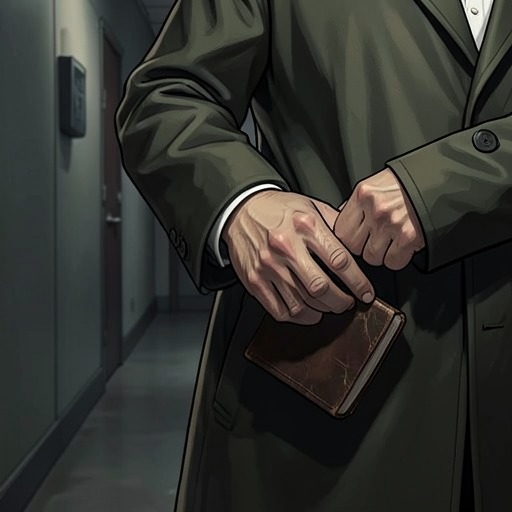
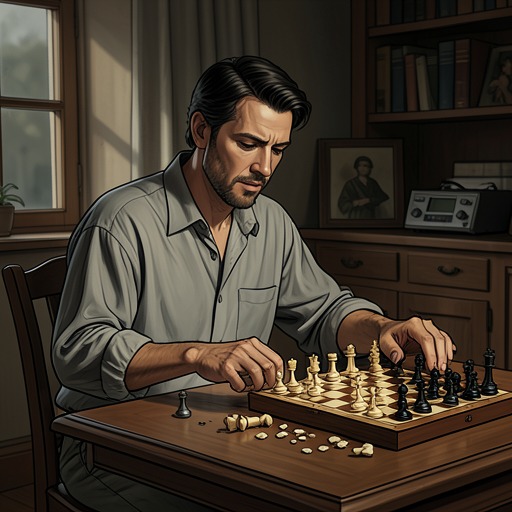
A stolen chess almanac supplies that task. The book contains 150 grandmaster matches, recorded in diagrams and notation that Dr B initially cannot understand. He learns to reconstruct the positions on a check-patterned bedcover and makes crude chess pieces from crumbs of bread. After repeated attempts, he can play a match through to its conclusion; in stages, he no longer needs the crumbs, then the bedcover, and can visualize the positions internally. He eventually memorizes every match and schedules his days around playing them: two in the morning, two in the afternoon, and a review in the evening. This routine gives shape to otherwise unstructured days and, as he recounts it, restores clarity and discipline to his thinking.
The refuge has a limit. After about two and a half or three months, the 150 games have each been repeated so many times that their sequences arrive automatically. Their once-stimulating turns no longer surprise him, and the memorized book cannot provide new matches. Dr B sees invention as the only remaining way to sustain the mental exertion that had helped him endure confinement. The attempt to play against himself begins not as a freely chosen pastime, but as his response to the collapse of the one occupation available to him.
The Paradox of Two Players in One Mind
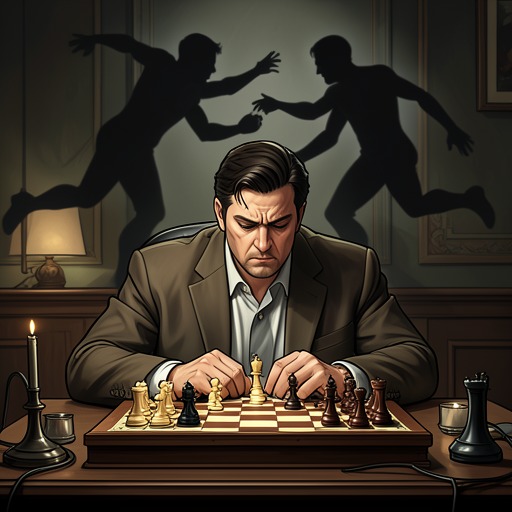
Dr B explains the basic contradiction through the structure of chess itself. Its contest depends on separate minds: each side tries to anticipate, frustrate, or answer an opponent whose plans remain concealed. If the same person controls both colors, that person must know a plan and, at the same time, somehow not know it. Playing as white, he would have to set aside what he had intended as black; playing as black, he would have to treat the other side’s intentions as genuinely uncertain. For Dr B, this is not simply a difficult exercise in concentration but a demand for a division of awareness that cannot be cleanly commanded.
A real board might have offered a degree of separation. With physical pieces, Dr B imagines, a player could pause and shift bodily from one side of the table to the other, viewing the position first as black and then as white. But in confinement he has no board or pieces. He must hold all sixty-four squares in his mind, maintain the current position, and calculate possible future moves for both sides. He describes working four or five moves ahead for each color, considering the resulting positions repeatedly. The abstract exercise removes even the material boundary that might have helped distinguish one player from the other.
This marks a sharp contrast with his earlier use of the almanac. Replaying other people’s matches had been a bounded task with a source outside himself: the book preserved the moves, and Dr B could follow the strategies of grandmasters as a spectator and student. The victor’s ambition belonged to the players in the recorded games, not to him. When he invents games against himself, that protective distance disappears. His two imagined sides each acquire a will to win, and the intellectual contest becomes a confrontation in which he is both the source of opposition and its target.
From Discipline to Compulsion
At first Dr B tries to manage the new exercise deliberately, taking breaks between matches to recover. But the opposing selves begin to animate the game: each presses for advantage, celebrates the other’s mistakes, and resents its own. Dr B connects this change to the anger and desire for vengeance accumulated during months of imprisonment. With no other contest available, he directs those feelings into the imagined match. The act that had been meant to stave off mental atrophy thus gathers emotional force as well as intellectual complexity.
The breaks soon disappear. One match follows another because each imagined self demands a chance to answer defeat. Dr B cannot estimate how many he plays in the final months of confinement—perhaps a thousand or more—and describes chess thoughts as taking over his waking hours and entering his sleep. Even interruptions become unwelcome because he wants to return to the game. The progression is consequential: chess begins as a repeated but finite schedule, then becomes an activity he cannot readily stop or contain.
His account also distinguishes this compulsive invention from the earlier memorization that had seemed restorative. Playing through recorded matches meant repeating fixed material, with the almanac available as an external reference if he lost his place. Inventing both sides requires him to generate the opposing plans himself, without that outside support. What had calmed his nerves by giving thought a limited field now pulls him into an unbounded contest between rival versions of his own mind. The same game therefore stands on both sides of a reversal: first a structure that helps him endure isolation, then the form through which the strain of isolation intensifies.
Release, Retrospective Doubt, and the Unfinished Test
After Dr B is released, he does not immediately recall the experience in full. He says that attempts to think back to the cell initially leave his mind blank; only weeks later, aboard the ship, does he find the courage to remember and recount what happened. His account of chess against himself is therefore also a return to an experience that had remained difficult for him to approach. The story presents the memory as delayed rather than as a settled explanation of his mental state.
That uncertainty shapes his encounter with chess played by other people. When he sees a real board and pieces, he is astonished that chess exists outside the abstract exercises he attempted in isolation. He has to reconnect the notation and imagined positions with movable pieces, and he intervenes in a game after one player makes a move he considers mistaken. He later recognizes that his intervention was improper. The episode shows how completely his solitary practice had altered his immediate relation to the ordinary, shared form of the game.
Dr B agrees to a single match as a test of whether he can play normally on a real board against a living opponent. He does not claim that his hundreds or perhaps thousands of imagined games prove that he can compete with a grandmaster; he is unsure whether they were proper chess at all or a fevered form in which steps passed as they do in dreams. He describes the proposed game as a way of finding out how close he had come to madness, not as the start of a new career or challenge. He also insists that he will play only once, because he fears that returning to chess might revive the obsession. The concept ends, then, not in a verdict about whether the experiment counted as real chess, but in a guarded trial whose very limit reflects the danger Dr B associates with playing against himself.